
Audio for the SHAQ ASL broadcast from Atlas Arena – Lawo mc²96 with Waves SoundGrid and DAD AX Center
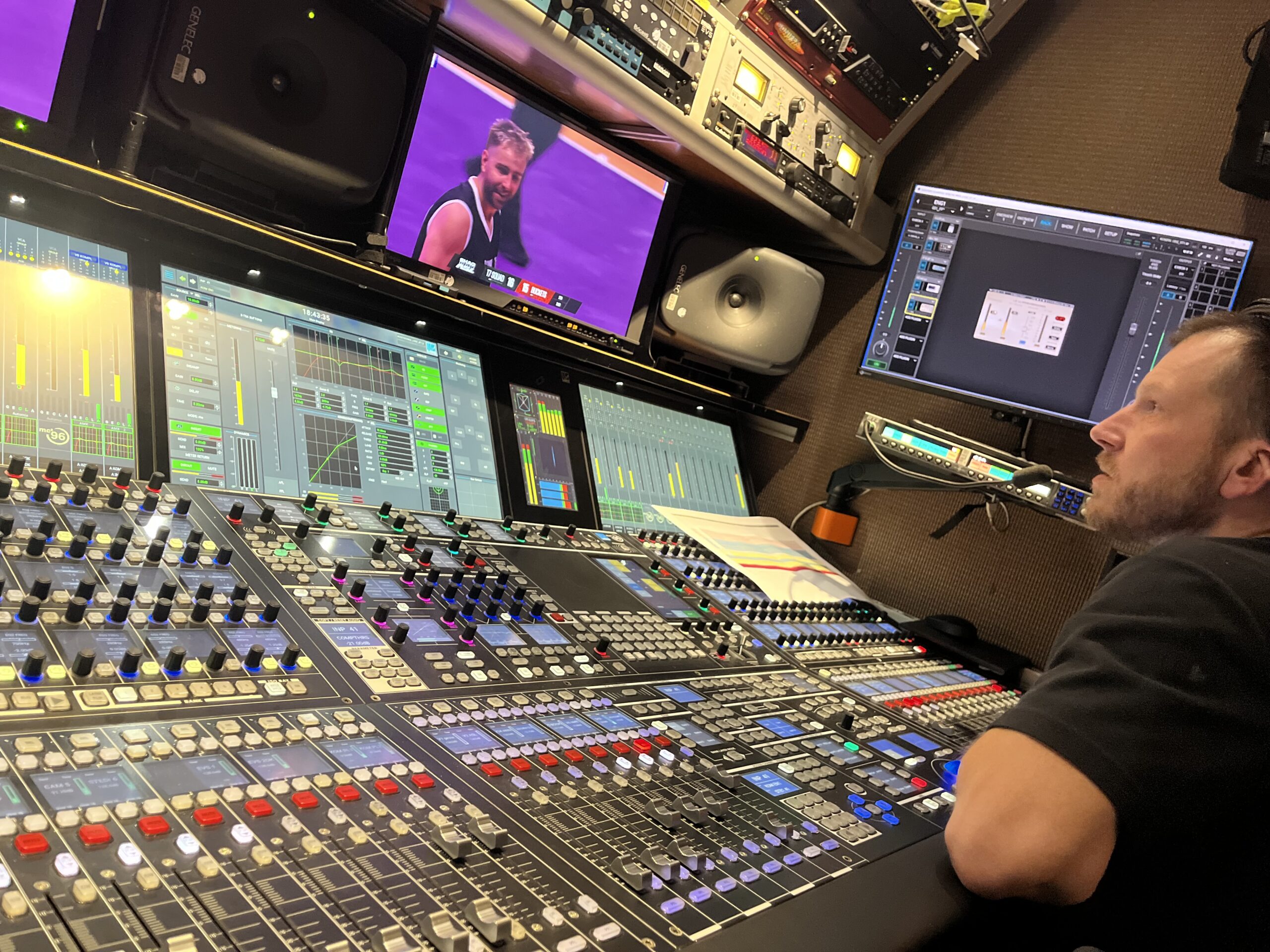
On 3 October 2026 we produced the live broadcast of SHAQ Presents All Stars League III from Atlas Arena in Łódź, Poland, with the TVN S.A. OB VAN 3 HD – the full production is described in the broadcast case study. This page covers one area: sound. Sound engineer Tomasz Kramarczyk (Forfiter Audio) combined the truck’s Lawo mc²96 console and Waves SoundGrid system with his own processing chain – a DAD AX Center interface with UAD plug-ins and AI ambience-reduction plug-ins (Live Professor on a MacBook) – and delivered three masters: Polish, English and international. Krzysztof Kurek mixed the English version. The audio chain description was prepared by Tomasz Kramarczyk.
At a glance
| Event | SHAQ Presents All Stars League III, Atlas Arena, Łódź, 3 October 2026 |
| Client | All Stars League Sp. z o.o. |
| OB van | TVN S.A. OB VAN 3 HD, 1080p50 |
| Console | Lawo mc²96 |
| Processing | the truck’s Waves SoundGrid on input channels; own chain: DAD AX Center with UAD and AI ambience-reduction plug-ins (Live Professor) on groups; TC Electronic System 6000 (MD4) finalizer on the masters |
| Masters | 3: Polish with commentary, English with commentary, international (IFL) without commentary |
| Sound engineers | Tomasz Kramarczyk (main mix, Forfiter Audio), Krzysztof Kurek (English version) |
The audio brief
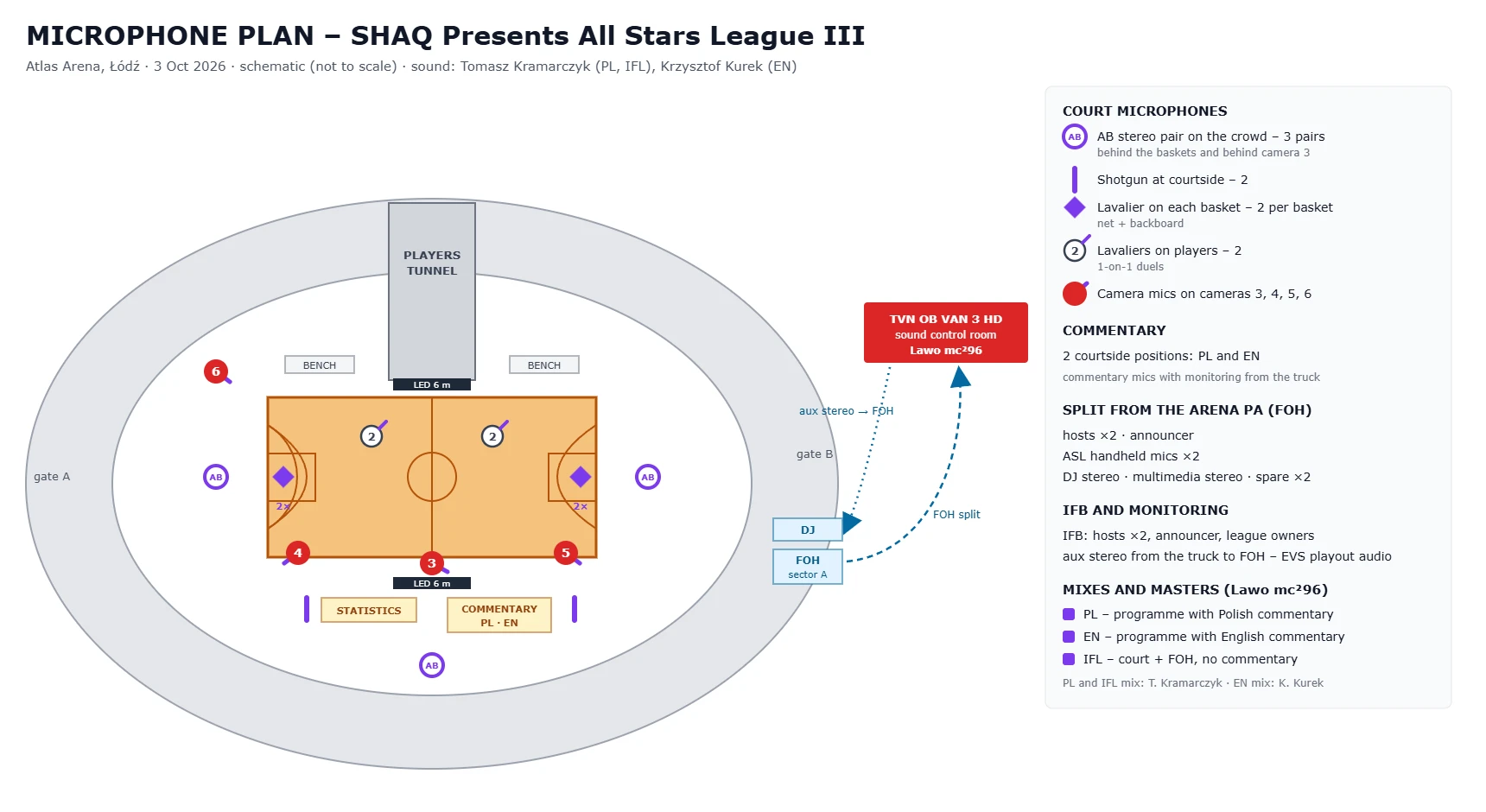
A sports show in a concert arena: games, a dunk contest, stunt shows, a DJ, multimedia, pyrotechnics, hosts and an announcer – plus two commentary positions at courtside. Into the truck came: a split from the arena PA, microphones on the baskets (net and backboard), microphones on players in 1-on-1 duels, camera microphones, shotgun microphones at courtside, three stereo pairs on the crowd and commentary in two languages; plus IFB for the hosts, the announcer and the league owners.
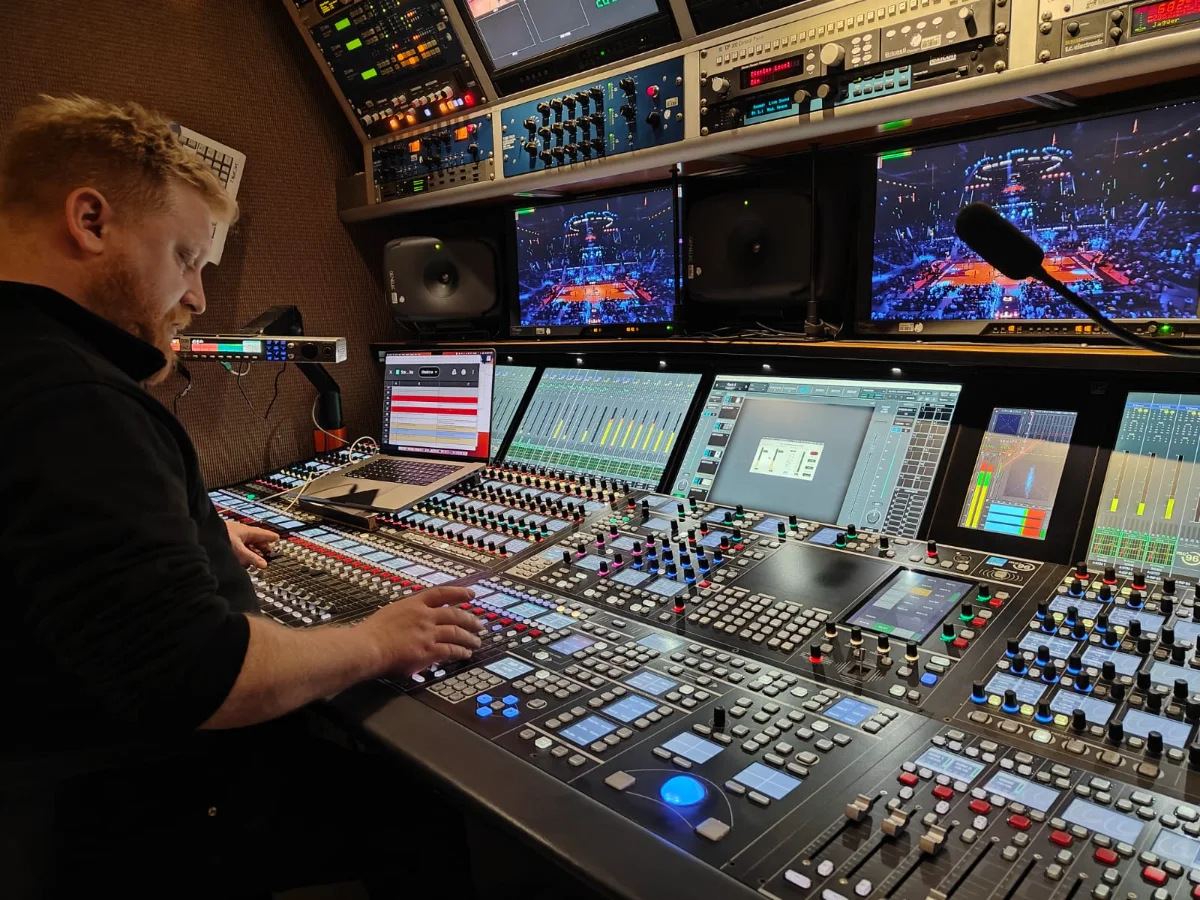
From all this, three audio versions were needed for the PPV platform and streaming: Polish with commentary, English with commentary and international – court and PA, no commentary. Two separate mixes were run by two engineers: Tomasz Kramarczyk (Polish version and international sound) and Krzysztof Kurek (English version, with independent monitoring). The whole rig, video included, was installed in one day.
Microphone plan
On the court: three AB stereo pairs on the crowd (behind both baskets and behind camera 3), two shotguns at the boards, two lavaliers on each basket (net and backboard), lavaliers on players in 1-on-1 duels and camera mics on cameras 3, 4, 5 and 6. The PL and EN commentary positions sat courtside, behind the LED boards. A split from the arena PA (FOH, sector A) fed the truck with the hosts, the announcer, the league representatives’ handheld mics, the DJ, multimedia and two spare channels; an aux stereo with EVS playout audio went back from the truck to FOH.
The audio chain, step by step
- Mixing on the Lawo mc²96. All sources went into the truck’s Lawo mc²96 console – this is where the mix was built and where the masters were sent to video.
- The truck’s Waves SoundGrid on input channels. Waves plug-ins on the truck’s SoundGrid server ran on the channel inserts, including Vocal Rider (automatic voice level riding), CLA-76, CLA-2A and dbx 160 compressors, PuigTec EQP-1A EQ, L2 limiter and SSL compressor. SoundGrid processes them outside the console with very low latency.
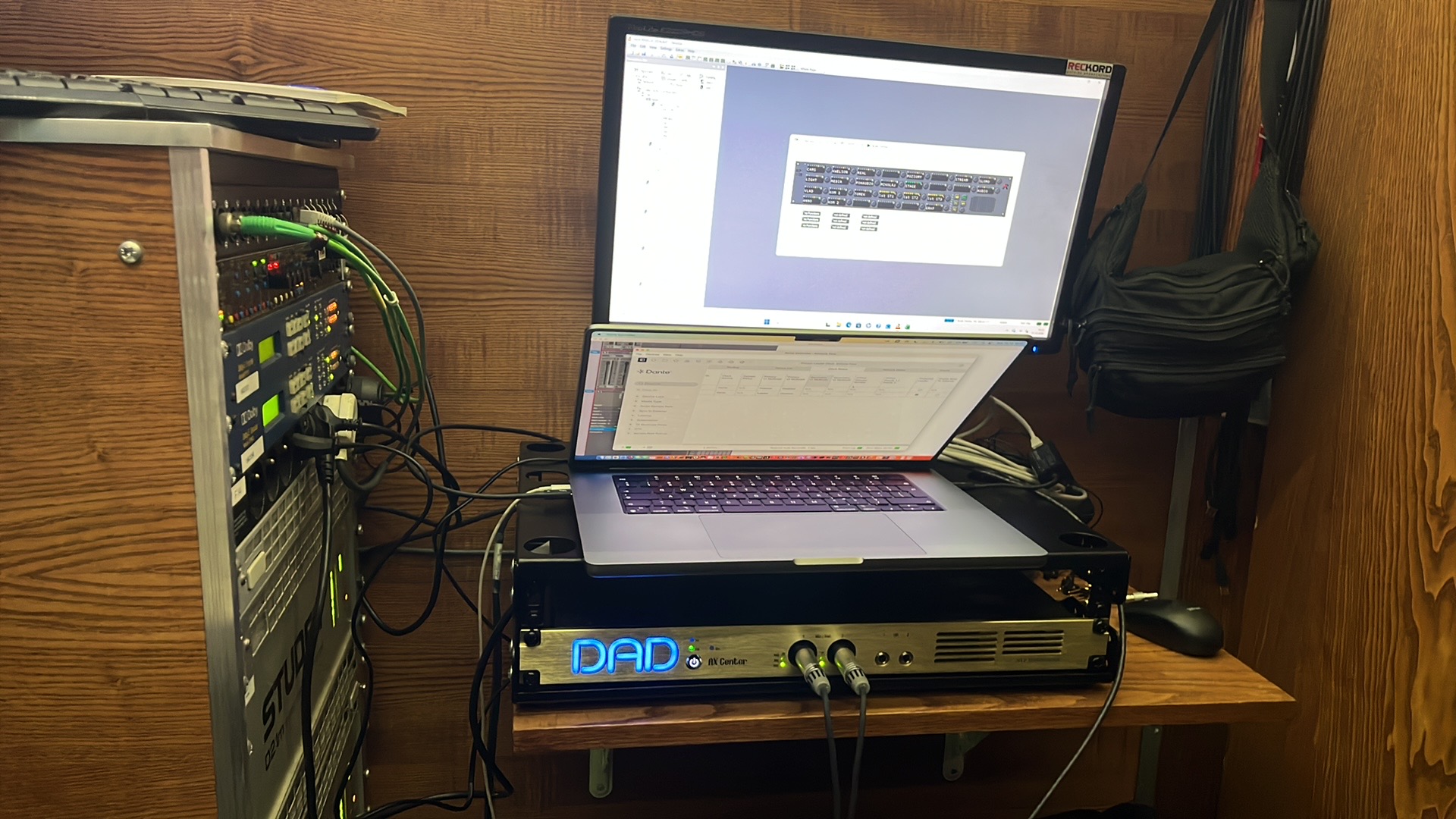
- Groups: Live Professor and UAD via DAD AX Center. Input channels were mixed to groups, with Live Professor inserts running on a MacBook Pro (M2 Pro). The bridge was a DAD AX Center interface: connected to the truck system via optical MADI (multimode SFP module) and to the computer via Thunderbolt 3. Round-trip latency was 3–4 ms and the connection stayed stable for the whole broadcast. The groups used AI-based plug-ins to reduce arena ambience, plus UAD plug-ins including SSL.
- A finalizer on all three masters. The Polish, English and international masters went through the MD4 algorithm of a TC Electronic System 6000 (M6000), giving all three versions the same controlled loudness and dynamics.
- One clock for the whole system. The SoundGrid network (servers) and the DAD processor were locked to the truck’s master clock – the entire audio chain ran on one common clock.
Why DAD AX Center
- Thunderbolt 3 to the computer – a low-latency, reliable connection with 256 inputs and 256 outputs.
- Routing and formats – MADI coax, optical MADI, Dante (256 channels), analogue, AES/EBU (e.g. via an ADAT, MADI or Dante converter), ADAT, plus two expansion cards (analogue, AES/EBU, Dante, MADI, embedder, AES67). It plugs into practically any format a truck or venue has.
- Capacitor-free analogue path – two high-end microphone preamps and four analogue outputs with no capacitors in the signal path: clean phase and full low-end response.
- Monitoring – two high-quality headphone amplifiers to listen to any input or output.
- 1U, light and mobile – the whole external processing chain is one 1U unit and a laptop. It can travel to any OB van, anywhere in the world.
What it gave the broadcast
- Clear commentary over a loud arena – dynamics control and ambience reduction on channels and groups.
- Three masters with consistent loudness – one finalizer across all language versions.
- A 3–4 ms chain, stable from the first minute to the last and locked to the truck.
- Repeatability: the same processing chain goes into any OB van, whatever the console brand.
Audio team
- Tomasz Kramarczyk – sound engineer, main mix: Polish version and international sound; Forfiter Audio.
- Krzysztof Kurek – sound engineer for the English version, with independent monitoring.
- Production and broadcast direction: Marcin Prause. OB van and technical crew: TVN S.A. Client: All Stars League.
FAQ
Can you use your own plug-ins in an OB van? Yes. We patch an external processing chain (Live Professor and UAD plug-ins via DAD AX Center) into the truck’s console via MADI and lock it to the truck’s clock – as we did at Atlas Arena, alongside the truck’s Waves SoundGrid system.
What is international sound (IFL)? A mix without commentary – court and arena PA – for broadcasters and platforms adding their own commentary. At Atlas Arena it was the third master alongside the Polish and English versions.
How do you handle a broadcast in two languages? Two commentary positions at courtside, two sound engineers with independent monitoring, separate Polish and English masters, and an international sound pair on every feed.
How much latency does external audio processing add? At Atlas Arena 3–4 ms round trip (DAD AX Center over Thunderbolt 3) – a fraction of one video frame, with no effect on lip sync.
Planning a two-language broadcast or a demanding audio production in Poland?
We produce it from an HD or 4K UHD OB van, with sound engineers and their own processing chain, in any arena in Poland. Call +48 792 772 873 or email marcin@prause.pl.